Match Lineups widget displays soccer match starting lineups and substitutes with tactical formations visualized on a football pitch. The widget shows both teams' formations (e.g., 4-4-2, 4-3-3) with interactive player positioning, detailed player lists including jersey numbers and substitutions, manager information, and optional injury/absence data. It features a slide mechanism for switching between teams, responsive layouts optimizing for different screen sizes, and interactive player selection for integration with player profiles or statistics. The widget supports both matches with confirmed formations and pre-match scenarios with squad lists only.
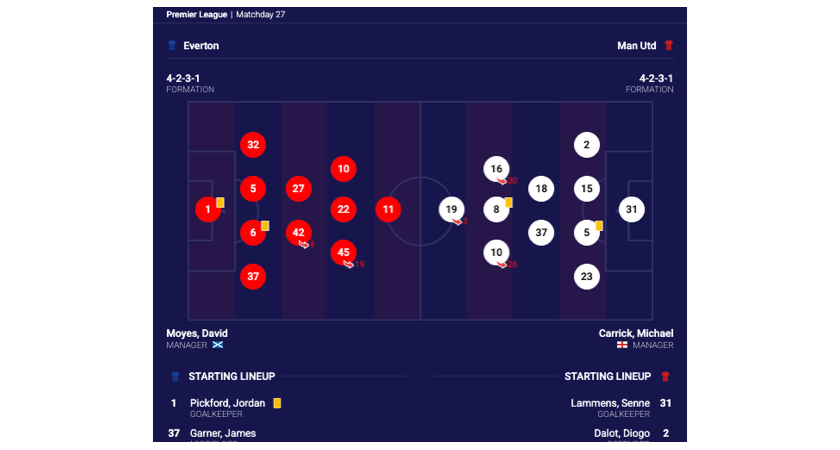
Shows the default view of the Match Lineups widget.
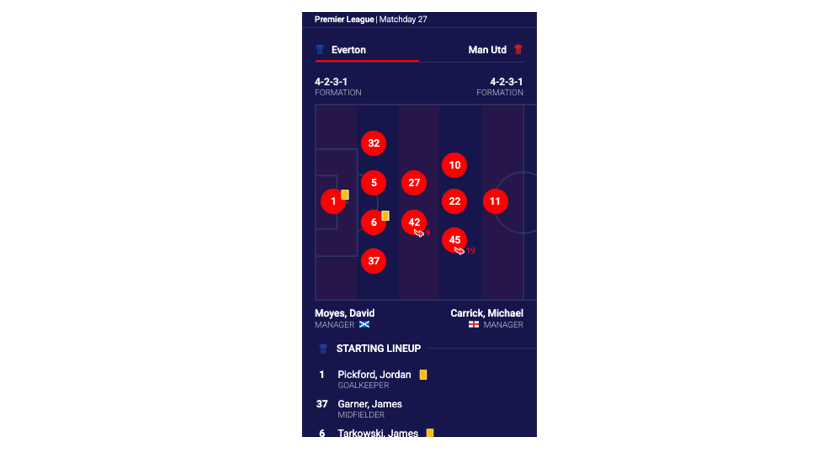
Shows the Match Lineups widget in a mobile-friendly layout for narrow screens.
See the Match Lineups widget demo.
#API Reference
#Required Parameters
- widget-name:
match.lineups - matchId: The unique identifier for the match is the only required parameter. See Getting Identifiers
Environment Requirements
Technical Requirements:
- JavaScript enabled
- XMLHttpRequest support for data fetching
- CSS3 support for styling and animations
Supported Sports
The Match lineups widget supports the following sports:
| Sport | Sport ID |
|---|---|
| Soccer | 1 |
#Main Configurable Features
Illustrations of main feature variants with relevant property values below.
Shows the default view of the Match Lineups widget.
#Integration Examples
#Property Name Transformations
Properties do not always transfer from the above table directly into integration code. Properties must be transformed differently for each integration method:
JavaScript/Programmatic Integration
- Property names remain unchanged in camelCase
- Properties become members of the 4th parameter object in
SIR()call - Example:
cardVariant: "compact"
info
In javascript integration, the properties go into an object which is passed as the 4th argument of the call ti SIR() function. Please see Global SIR API
HTML/Declarative Integration
- Convert camelCase to lowercase with dashes, e.g. cardVariant becomes card-variant
- Add
data-sr-prefix - Example:
cardVariant→data-sr-card-variant